Language Learning Platforms for Appointment Setters Sharpen Your Sales Communication Skills
· 19 min read

Introduction: The Hidden Career Accelerator in Sales Support
Imagine you land an interview for a remote appointment setter role. You know the product. You have a quiet workspace. You even practiced your opening script. But when the hiring manager asks you to handle a mock objection, you freeze. The words get tangled. Your confidence drops.
This moment is more common than you think. Many job seekers focus on resumes, job boards, and interview tips. They overlook something just as important. The way you speak and write can make or break your shot at a high-value remote sales support career.
Here is the thing. Appointment setting is not just about dialing numbers or sending emails. It is about building trust in seconds. You need clear verbal and written communication to connect with prospects. You need the right words at the right time. And you need the confidence to keep going when a conversation gets tough.
That is where language learning platforms come into the picture.
These tools are no longer just for travelers or students. In 2026, smart job seekers use them to sharpen their communication for sales roles. Organizations with strong communication practices are 3.5 times more likely to outperform their peers, according to research from Quantified. That same principle applies to individuals. The better you communicate, the more valuable you become to employers like the ones advertising appointment setter jobs.
Think of it this way. Professional sales training delivers an average ROI of 353%. Every dollar invested comes back more than threefold. Language learning platforms work the same way for your personal career investment. They help you build vocabulary for sales conversations, improve your tone in writing, and reduce hesitation on calls.
Many people look for self-paced courses or online learning platforms to gain skills fast. But they often skip the foundational piece. Strong language ability makes every other skill work better. Whether you are learning lead generation, CRM tools, or objection handling, your language skills determine how well you apply them.
Some platforms even offer LinkedIn certifications that you can add to your profile. These credentials show hiring managers that you take communication seriously. They prove you have put in the work.
You might already have some sales instincts. You might be good with people. But deliberate language skill development is the hidden accelerator that pushes you ahead of other candidates. It closes skill gaps. It builds confidence. And it prepares you to handle real sales conversations with ease.
This guide will walk you through how to use language learning platforms to strengthen your appointment setting career. We will cover which skills matter most and how to practice them daily.
If you are new to this path, start by exploring the basics of appointment setting to understand what the role truly requires. Then come back here to build the communication skills that will set you apart.
Ready to upgrade your communication toolkit? Let us dive into the first skill that every top appointment setter masters.
Why Communication Skills Are the Backbone of Appointment Setting
The introduction gave you a taste of why language learning platforms matter. But let us zoom out for a moment. Why do so many appointment setters struggle even when they know the product inside out?
Here is the truth. Appointment setting is a communication-first job. Your product knowledge only matters if you can share it clearly, quickly, and convincingly. Every call starts with a first impression. You have about 10 seconds to earn a prospect’s attention.

If your tone sounds unsure, your words feel clunky, or you fail to listen actively, that call ends before it starts.
According to research from DemandZen, the must-have soft skills for appointment setters include listening and empathy during calls, clear verbal and written communication, and confidence.
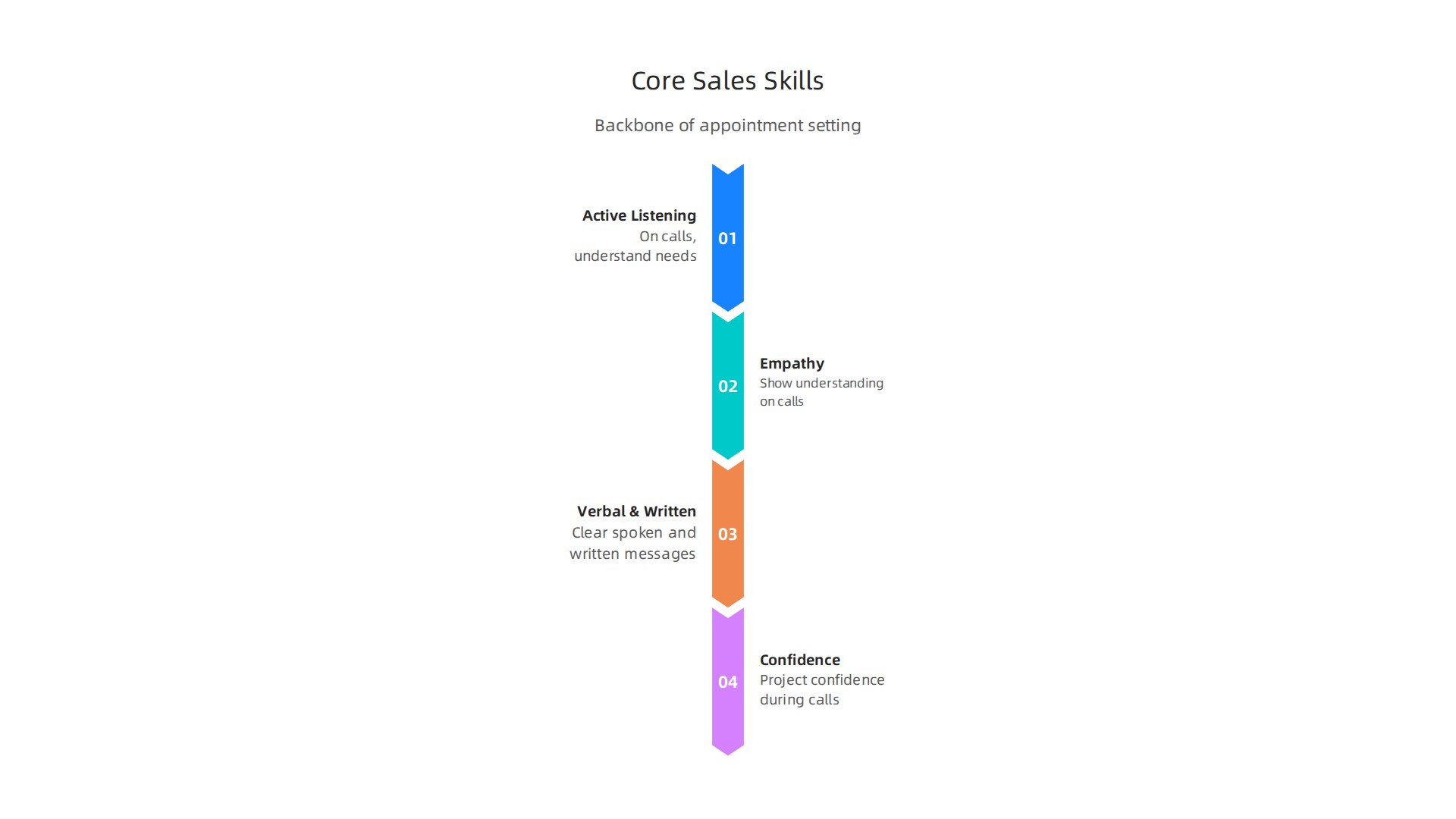
These are not nice-to-haves. They are the core of the role.
Active listening is another pillar. It is not just about hearing words. It is about picking up on a prospect’s hesitations, questions, and emotions. Then responding in a way that shows you understand. The best appointment setters turn objections into conversations. A data-backed guide from Prospeo reveals that top sellers who master three specific communication skills achieve a 72% win rate. That is a massive gap compared to average performers.
Clear value articulation is the third piece. You need to explain why a prospect should give you 15 minutes of their day. That takes precise language. You cannot ramble or use jargon. Your message needs to be simple, direct, and benefits-focused.
Studies back this up. Organizations with strong communication practices are 3.5 times more likely to outperform their peers, according to a report from Quantified. And professional sales training delivers an average ROI of 353%, as noted by Integrity Solutions. The same logic applies to individuals. Every hour you invest in improving how you speak and write multiplies your earning potential.
Many appointment setters fail not because they lack product knowledge, but because their communication fundamentals are weak. They stumble over words. They forget to ask the right questions. They sound robotic.
That is exactly where language learning platforms shine. They give you a structured way to practice the specific language of sales conversations. Instead of hoping you will get better on the job, you can train deliberately. Self-paced courses and online learning platforms let you focus on vocabulary for objections, tone control, and writing polished emails. Some even offer LinkedIn certifications that prove your skills to employers.
Think about it. If you can walk into an interview and handle a mock objection with confidence because you have practiced that exact scenario, you are already ahead.
Ready to take the next step? Explore our resources to find guides, tools, and tips for building the communication skills that will set you apart.
How Language Learning Platforms Can Fast Track Your Sales Communication Skills
So you know communication matters. But how do you actually get better at it without spending years in a classroom? That is where modern language learning platforms come in. They are built for exactly this kind of targeted practice.
Today’s best tools go way beyond basic vocabulary drills. Many offer sales specific modules that teach you exactly what to say during a discovery call or how to handle a price objection. You get role play simulations where a virtual prospect pushes back, and you practice your response in real time. Some platforms even give you instant feedback on your pronunciation and tone.
According to a 2026 comparison of corporate language training platforms, the top solutions now include evaluation criteria like business English focus, pricing models, and use case recommendations for different roles. That means you can pick a platform that is built for sales, not just general conversation.
Structured progress that self study cannot match
Here is the problem with trying to learn on your own. You guess what to practice. You skip the hard parts. You never know if you are improving. Language learning platforms fix that with structured tracking. You complete a module on handling objections, and the system quizzes you. It records your scores. It shows you where you still stumble.
This kind of feedback loop is powerful. A report from Preply shows that speaking a second language can boost job prospects and raise salaries by 5 to 20 percent.
That is real money for appointment setters who need to build trust fast with prospects.
Closing the gap for non native speakers
If English is your second language, you already know that accent and fluency can make or break a first impression. Prospects judge you quickly. A slight hesitation or unclear word can kill the call. Language learning platforms with speech recognition and pronunciation drills help you sound more natural. You practice until your delivery feels smooth.
Even native speakers benefit. These platforms force you to slow down and choose your words carefully. You learn to avoid filler words and speak with confidence.
The best part? Many of these courses are self paced. You can fit them around your current job. Some even offer LinkedIn certifications that employers recognize. If you want to stand out when applying for remote appointment setter roles, having a certification from a platform like Coursera can give you an edge.
Ready to explore specific tools and courses that will sharpen your sales communication? Check out our curated blog resources for actionable guides and platform recommendations.
Key Features to Look for in a Language Learning Platform for Sales Professionals
Not every language learning platform will help you as an appointment setter. Some are built for travelers or general business users. You need specific tools that match what you actually do all day: talk to prospects and book meetings.
Here are the three features you should look for when you compare your options.
Sales Specific Vocabulary and Role Plays
Generic English lessons will not cut it. You need modules that teach you exactly what to say during a discovery call. You need to practice handling a gatekeeper. You need to practice responding to a price objection.
Look for platforms that include industry role plays. These let you practice your pitch in a safe space before you use it on a real lead. You can make mistakes and learn without losing a deal.
According to a 2026 comparison by Talaera of the best corporate language training platforms, the top solutions now include use case recommendations for different roles.

That means you can pick a platform that understands sales. Some even offer accent reduction tools. This is a big deal for non native speakers because clear pronunciation builds trust fast.
If you want to see how these tools fit into your overall skill set, check out our complete guide on the skills you need for remote appointment setting success.
Gamification and Spaced Repetition
Staying motivated is hard. You are busy. Studying feels like extra work. That is why you need a platform that makes learning addictive.
Gamification adds points, streaks, and levels. It turns practice into a game. You find yourself coming back just to keep your streak alive. This builds consistency.
Spaced repetition is even more powerful. The system shows you material right before you are about to forget it. This locks the information into your long term memory. You will remember your sales scripts and key phrases for months, not just hours.
A report from Preply shows that structured language learning can boost your job prospects and raise your salary. Gamification and spaced repetition make sure you actually finish the course and get those results.
Integration With Real Sales Tools
The third feature is practical integration. The best online learning platforms in 2026 let you connect your training to the tools you actually use at work.
You practice sending a calendar invite after a mock call. You practice logging a conversation in a simulated CRM. This bridges the gap between learning and doing. It makes the training feel real.
Top sales training platforms now include features that simulate these workflows. This kind of hands on practice builds confidence fast. When you go to book a real meeting, it feels like something you have already done a hundred times.
Once your communication skills are sharp, the next step is setting up your actual tech stack. Our guide on configuring Salesforce for appointment setting walks you through the exact steps to get your system ready.
What to Ignore
Do not get distracted by flashy graphics or huge vocabulary lists. Ignore platforms that teach you how to order food or talk about the weather. You need sales specific content, engagement tools, and real world integration. Those three features will help you book more meetings.
Ready to find the perfect platform and course path for your goals? Explore our blog for step by step guides, tool reviews, and practical advice on launching your remote appointment setting career.
Integrating Language Practice Into Your Daily Appointment Setting Workflow
You have chosen a great language learning platform. Now you need to weave that practice into your actual workday. The trick is to make it a habit that feeds your performance,

not another task that drains your energy.
Micro-Learning Sessions Before Your Call Blocks
Set aside 15 to 20 minutes right before you start dialing. Use that time on your platform to review key phrases, practice a quick role play, or run through a short vocabulary drill.

This warm up shifts your brain into sales mode and boosts your fluency before you speak to a real prospect.
A 2026 guide on appointment setting success from RevEmpire explains that preparation directly affects how confident you sound on the phone. Taking a few minutes to refresh your language skills is a simple form of that preparation. It turns your study time into a direct performance booster.
These short bursts work better than long sessions because they fit your schedule. You can do them between tasks. Many online learning platforms now offer self-paced courses with bite sized lessons perfect for this approach.
Record and Review Your Mock Calls
Your platform likely includes a tool to record your voice or simulate a call. Use it. Record yourself delivering your pitch. Then listen back and compare it to the platform feedback or to a native speaker example.
Listen for clarity, pacing, and tone. Did you stumble on a common objection phrase? Did your voice drop at the end of a sentence? This review process accelerates skill acquisition faster than just repeating lessons.
Effective remote team communication depends on clear speaking habits. According to Wing Assistant’s 2026 guide on remote team communication, consistent feedback loops are key to improving how you express yourself. Your own recordings become your personal feedback loop.
Pair Your CRM Scripts With Vocabulary Drills
Here is where things get real. Take the actual scripts or talking points you use in your CRM. Maybe you use a standard discovery call script or a common email template. Plug those phrases into your language platform’s vocabulary drills or flashcard system.
Practice saying your real lines until they feel natural. This creates direct transfer from your study time to your job performance. You are not learning random words. You are memorizing the exact language that books meetings.
For example, if your script includes a line like “I’d love to schedule a quick 15 minute call to see if this is a good fit,” practice that sentence until it rolls off your tongue without hesitation. Your platform may even let you create custom flashcard sets. Use that feature.
A complete guide on B2B appointment setting services from Leads At Scale emphasizes that refined messaging is a top priority for 2026. By aligning your language practice with your actual messaging, you make every study minute count.
Make It a Habit
Consistency matters more than intensity. Do your 15 minute micro sessions every morning. Review one recorded call each week. Update your flashcard deck whenever you update your script. Soon you will notice your calls feel smoother, you handle objections more naturally, and you book more meetings with less effort.
If you want a curated list of platforms and resources that fit this workflow, check out our blog for step by step guides and tool reviews. Start integrating language practice into your daily routine today.
Overcoming Common Communication Barriers in Remote Sales Roles
Working from home as an appointment setter comes with its own set of communication headaches. You can’t read body language. Audio delays mess up your timing.

And you have to navigate different time zones without sounding rude. These barriers can hurt your ability to build trust and book meetings, especially when you’re speaking a second language.
The good news is that language learning platforms designed for busy professionals can help you tackle these challenges head on. Let’s look at how.
The Three Biggest Remote Communication Hurdles
When you’re on a call without seeing the other person, you lose a lot of information. Facial expressions, hand gestures, and posture all carry meaning. Without them, you rely entirely on your voice. That makes clarity and tone extra important.
Audio delays add another layer of difficulty. A slight lag can cause you to talk over someone or pause awkwardly. You need to learn to slow down and leave tiny spaces for the other person to jump in.
And then there’s time zone etiquette. You might call a prospect at 9 AM your time, but it’s already 5 PM for them. You need to acknowledge their schedule and adjust your energy level accordingly.
According to Wing Assistant’s 2026 guide on effective remote team communication, clear protocols and consistent feedback loops are essential for remote teams. The same idea applies to your calls with prospects.
How Language Learning Platforms Solve These Problems
Good online learning platforms go beyond vocabulary. They train you on clarity, tone modulation, and active listening. Many self-paced courses include exercises where you practice speaking clearly and at the right pace. You can listen to recordings of your own voice and compare them to native speakers.
For example, some platforms let you record your pitch and then get feedback on your pronunciation and pacing. Others have listening exercises that sharpen your ability to catch key words through poor audio or accents. This directly helps you handle prospects who speak fast or have a strong accent.
Building rapport over the phone requires different skills than in-person sales. You need to use more verbal cues. Say things like "I understand," "That makes sense," or "Great point" to show you’re listening. Language platforms can drill these phrases until they feel natural.
The Readymode guide on appointment setting tips reminds us that phone calls let you confirm interest and answer questions in real time. But you can only do that well if your communication is clear. That’s where language practice pays off.
Put It Into Practice
Start by focusing on one barrier at a time. Maybe this week you work on speaking slower to handle audio delays. Next week you practice acknowledging time zones politely in your opening.
If you want to upgrade your skills even more, check out our guide on unlocking high-paying remote jobs with Coursera English courses. It shows how structured language training can boost your confidence and your booking rate.
View Resources to find more tools and courses that help you sound like a pro on every call.
Measuring Your Progress: Communication Skill Metrics That Matter
You have been using a language learning platform for a few weeks. You feel more confident. But how do you really know you are getting better? The answer is tracking the right numbers.
Most people guess their progress. They feel like they improved. But feelings can trick you. Real progress shows up in cold, hard data. And when you track that data, you can prove to yourself and your boss that your training is working.

Fluency Benchmarks: The Nuts and Bolts of Your Speech
Start with simple fluency metrics. How many words do you speak per minute? Most native speakers land between 140 and 160 words per minute in a conversation. If you are slower than that, you might sound hesitant. If you are faster, you might sound rushed.
Count your filler words too. Words like "um," "uh," "like," and "you know" kill your credibility. Record yourself reading a script for two minutes. Count the filler words. Aim to get that number below three per minute.
Many language learning platforms give you proficiency scores after each exercise. These scores measure your pronunciation, grammar, and pacing. Watch those scores trend up over time. A steady climb means you are building real skill.
According to the Pitchbase 2026 guide on calculating sales training ROI, eight key metrics help you measure training effectiveness. Fluency benchmarks are one of them.
Call Outcome Metrics: What Actually Matters
Fluency is nice, but do you book more meetings? That is the metric that pays the bills.
Track your booking rate. If you made 50 calls and booked 10 meetings, your rate is 20%. After 30 days of platform use, compare that rate to your baseline. A jump of even a few points means your communication skills are converting.
Talk-time ratio is another hidden gem. What percentage of the call are you speaking vs. the prospect? Top salespeople listen more than they talk. A good target is 40% talk time for you, 60% for the prospect. If your talk time drops after training, that means you are asking better questions and letting prospects open up.
Prospect feedback matters too. After a call, ask the prospect how clear your message was. Their honest answer tells you more than any quiz score.
The tldv 2026 guide to sales skills suggests a 30-day plan where you score your own calls using a simple rubric. That same idea works perfectly for tracking your language progress.
Before-and-After Comparison: The Best Proof
Here is the most powerful method. Record your first call before you start any training. Then record another call after 60 days of consistent practice on your language learning platform.
Listen to both recordings back to back. You will hear the difference. Your pace will be steadier. Your filler words will be fewer. Your tone will sound more natural. That comparison is impossible to argue with.
If you want to upgrade your skills even more, check out our guide on unlocking high-paying remote jobs with Coursera English courses. It shows how structured language training can boost your confidence and your booking rate.
View Resources to find more tools and courses that help you sound like a pro on every call.
Summary
This article explains how deliberate language practice—using modern language learning platforms—can accelerate a remote appointment setter career. It shows why communication is the core skill for booking meetings, how platforms deliver targeted role plays, pronunciation feedback, and sales-specific vocabulary, and which features actually move the needle. You’ll learn how to fold short, high-impact practice sessions into your calling workflow, record and review mock calls, and align your CRM scripts with flashcards so study transfers directly to live conversations. The guide also covers common remote communication barriers (audio delays, no body language, time zones) and practical fixes, plus the key metrics to track progress like booking rate, talk-time ratio, filler words, and before/after recordings. By following these steps you’ll improve clarity, confidence, and measurable meeting outcomes that hiring managers and teams value.